How Much Does Courier Management Software Cost in India? (2026 Pricing Guide)
Tue Jul 14 2026 · DigiBuilt Team
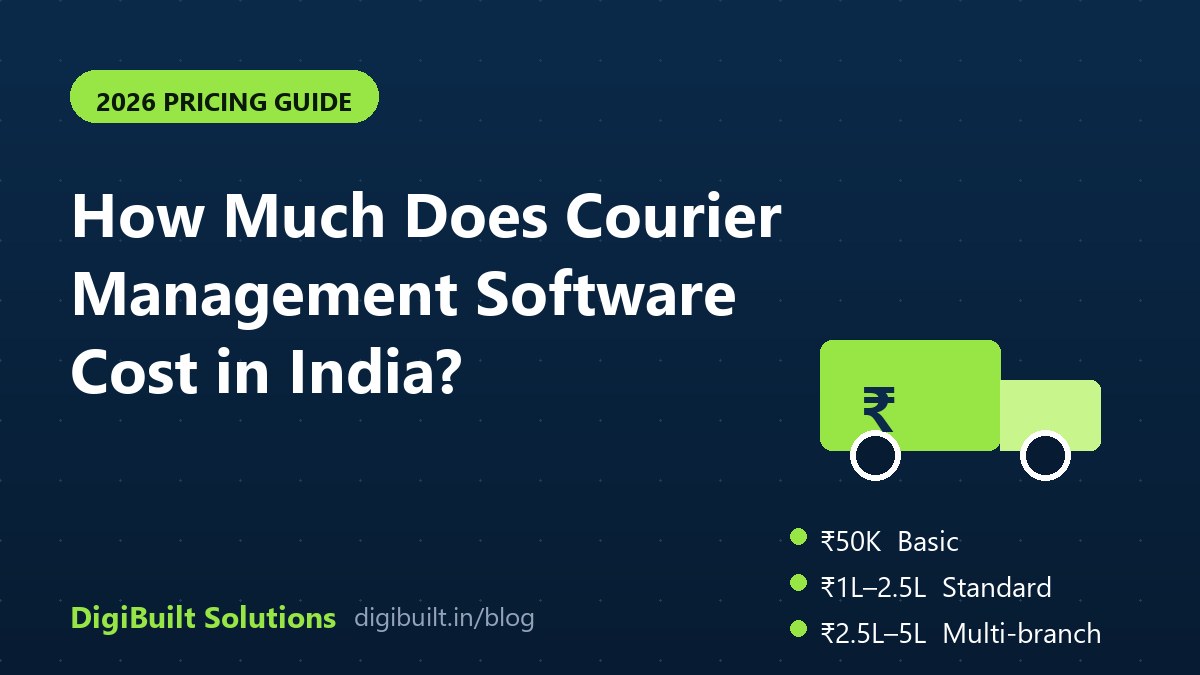
Table of Contents
- 1. The Short Answer: ₹50,000 to ₹5,00,000+
- 2. Tier 1: Basic Booking & Tracking Panel (₹50,000 – ₹1,00,000)
- 3. Tier 2: Standard Platform with COD & Billing (₹1,00,000 – ₹2,50,000)
- 4. Tier 3: Multi-Branch + Driver App (₹2,50,000 – ₹5,00,000)
- 5. Ready-Made SaaS vs Custom Development
- 6. Hidden Costs to Ask About
1. The Short Answer: ₹50,000 to ₹5,00,000+
Courier management software in India ranges from ₹50,000 for a basic booking-and-tracking panel to ₹5,00,000+ for a multi-branch platform with driver apps and courier-partner API integrations. Where you land depends on four things: how many branches you run, whether you need a driver mobile app, how you handle COD, and which third-party couriers you integrate with. This guide breaks each tier down so you can budget before talking to any vendor.
2. Tier 1: Basic Booking & Tracking Panel (₹50,000 – ₹1,00,000)
This covers a single-branch courier operation: an admin panel to create shipments, generate consignment numbers and labels, and a public tracking page where customers enter an AWB number to see status updates. Staff update statuses manually. This tier suits local and regional couriers doing up to a few hundred shipments a day who currently run on registers or Excel.
If your team spends more than an hour a day answering 'where is my parcel' calls, even this basic tier typically pays for itself within months.
3. Tier 2: Standard Platform with COD & Billing (₹1,00,000 – ₹2,50,000)
The most common tier for growing couriers. Adds automated COD reconciliation (which shipments collected cash, which branch holds it, what is owed to which client), client-wise rate cards and monthly invoicing, SMS/WhatsApp status notifications, and basic reports. COD reconciliation alone is usually the reason companies upgrade — manual COD tracking is where money silently leaks.
Ask any vendor specifically how COD reconciliation works branch-by-branch. If the demo can't show you an outstanding-COD report per branch, keep looking.
4. Tier 3: Multi-Branch + Driver App (₹2,50,000 – ₹5,00,000)
For couriers with multiple branches or franchisees: branch-level dashboards with permission control, franchise billing, a driver/pickup-boy Android app with proof-of-delivery capture (photo + signature), route assignment, and integrations with national courier partners (Delhivery, DTDC, Blue Dart APIs) for shipments beyond your own network. GST-ready accounting exports are standard at this tier.
5. Ready-Made SaaS vs Custom Development
SaaS courier tools charge ₹5,000–₹25,000 per month, per branch in many cases. That's cheaper in month one, but over 3–4 years a custom platform you own outright usually costs less — and it matches your exact workflow instead of forcing your operations into someone else's template. SaaS makes sense if you're testing the business; custom makes sense once the courier operation IS the business.
Rule of thumb: if your projected 3-year SaaS spend exceeds ₹2,00,000, get a custom-build quote before renewing.
6. Hidden Costs to Ask About
Whatever tier you choose, confirm these before signing: hosting and server costs (₹500–₹3,000/month typically), SMS/WhatsApp gateway charges (per-message, paid to the gateway), annual maintenance (10–20% of project cost is standard), and data migration from your existing Excel/registers. A serious vendor lists all of these upfront in the proposal.
Need Courier Management Software?
Get a custom quote for your courier business — we build booking, tracking, and COD reconciliation platforms used by real courier companies.
Want to know about our services?
Message us on WhatsApp or call us. We reply quickly and explain everything in simple words.
Frequently Asked Questions
What is the minimum cost of courier software in India?
A basic single-branch booking and tracking panel starts around ₹50,000–₹1,00,000. Platforms with COD reconciliation and billing typically run ₹1,00,000–₹2,50,000.
Is custom courier software better than SaaS subscriptions?
If your 3-year SaaS spend would exceed roughly ₹2,00,000, custom software you own usually costs less long-term and fits your workflow exactly. SaaS is better for testing a new courier business.
How long does courier software development take?
A standard booking + tracking + COD platform takes 4–8 weeks. Multi-branch systems with driver apps take 10–16 weeks depending on integrations.
Related Posts
WhatsApp AI Agents in India (2026): Meta Business AI vs a Custom AI Agent
Meta launched AI assistants for WhatsApp businesses in India in 2026. Here is what was announced, what is still unclear, and when a built-in assistant is enough versus when you need a custom agent.
Read More →AI Adoption in Indian MSMEs (2026): What the Latest Surveys Actually Show
Two 2026 surveys give very different answers on how many Indian small businesses use AI. We explain why the numbers differ, where adoption is highest and what a small business should do first.
Read More →