5 Signs Your Business Needs a Custom CRM (Not Another SaaS Subscription)
Tue Jul 28 2026 · DigiBuilt Team
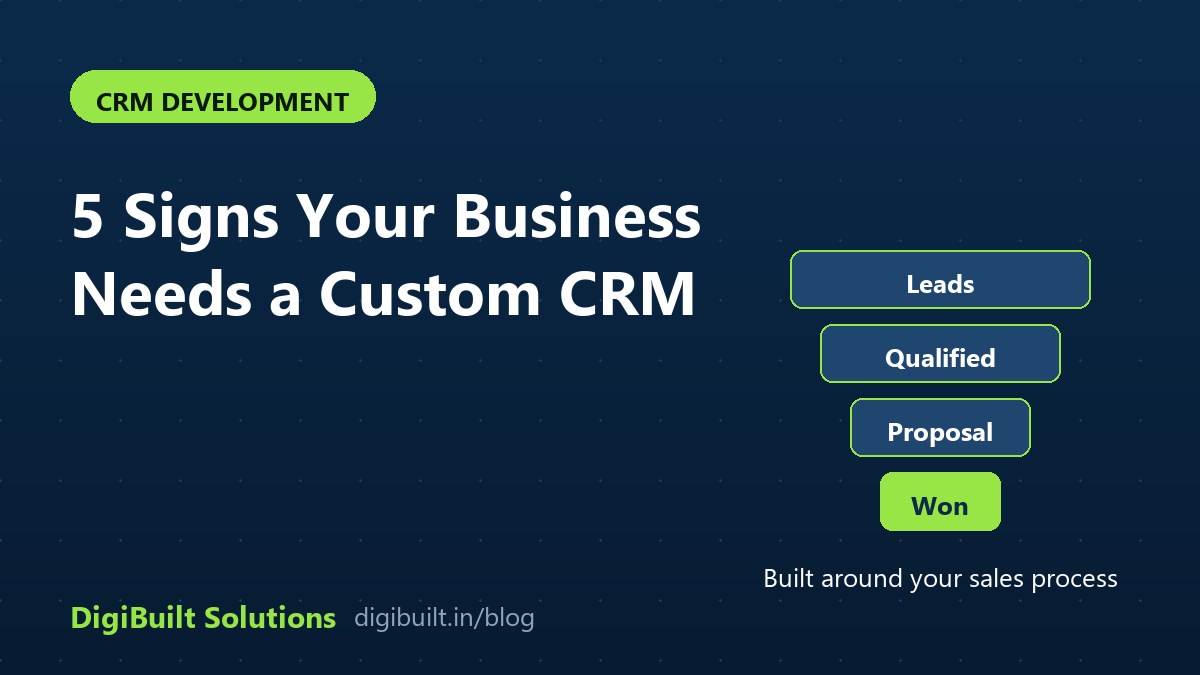
Table of Contents
1. The SaaS CRM Trap
Most businesses start with Zoho, HubSpot, or Salesforce because signing up takes five minutes. Six months later, the story is familiar: the team uses 10% of the features, fights the other 90%, pays per-user fees that grow with headcount, and maintains a parallel Excel sheet for everything the CRM 'doesn't quite do'. That parallel sheet is the tell — it means the tool doesn't fit the process.
2. Sign 1: Your Sales Process Doesn't Fit Their Pipeline
SaaS CRMs assume a standard funnel: lead → qualified → proposal → closed. But if you sell with site visits, sample approvals, credit checks, or recurring collections (chit funds, subscriptions, AMCs), you end up abusing pipeline stages and losing visibility. When your team stops updating the CRM because 'it doesn't match how we sell', the data dies.
A custom CRM models YOUR stages — including approval loops and recurring collection cycles — so updating it is natural, not a chore.
3. Sign 2: Per-User Pricing Is Punishing Your Growth
₹1,500–₹4,000 per user per month sounds fine at 5 users. At 25 users it's ₹4,50,000–₹12,00,000 per year, forever, with annual price hikes you don't control. A custom CRM is a one-time build (typically ₹2,00,000–₹6,00,000) plus modest hosting — the crossover point usually arrives between 10 and 20 users.
Do the math: multiply your seat cost by team size by 36 months. If that number exceeds a custom build quote, you're renting what you should own.
4. Sign 3: WhatsApp Is Your Real Sales Channel
In India, deals happen on WhatsApp — but most global SaaS CRMs treat WhatsApp as an afterthought or an expensive add-on. If your reps copy-paste between WhatsApp and the CRM, messages go unlogged and follow-ups slip.
Custom CRMs built for Indian sales teams integrate the WhatsApp Business API natively — conversations logged against leads, template follow-ups triggered by stage changes.
5. Sign 4: You Need Reports the SaaS Can't Produce
Owner needs collections-due-this-week by branch; SaaS gives you 'deal velocity by quarter'. If management runs on custom Excel reports built from CRM exports every Monday, the CRM isn't serving the business — someone is serving the CRM.
6. Sign 5: Your Data Must Stay Yours
Client databases in some industries (finance, healthcare, government vendors) carry compliance and confidentiality obligations. With SaaS, your data lives in their cloud under their terms, and exporting everything cleanly on exit is rarely painless. A custom CRM on your own server means your client list never leaves your control.
7. When SaaS Is Still the Right Answer
To be fair: if you have under 10 users, a standard funnel, and no unusual integrations, stay on Zoho or HubSpot — custom development would be overkill. Custom CRM makes sense when at least two of the five signs above apply. The worst position is paying enterprise SaaS prices AND fighting the tool; that's when the switch pays for itself fastest.
Bring your current CRM pain list to a development consult — a good vendor will tell you honestly if custom is overkill for your case.
Need CRM Development?
We build custom CRMs around your exact sales process — lead pipeline, WhatsApp integration, collections tracking, and reports your team will actually use.
Want to know about our services?
Message us on WhatsApp or call us. We reply quickly and explain everything in simple words.
Frequently Asked Questions
How much does custom CRM development cost in India?
A standard custom CRM (leads, pipeline, contacts, tasks, reports) costs ₹2,00,000–₹6,00,000 one-time, versus recurring per-user SaaS fees. The crossover vs SaaS usually falls at 10–20 users.
Can a custom CRM integrate with WhatsApp?
Yes — the WhatsApp Business API can be integrated natively so conversations log against leads and follow-up templates trigger automatically on pipeline stage changes.
How long does custom CRM development take?
A focused custom CRM takes 6–10 weeks to build and deploy, including data migration from your existing CRM or Excel sheets.
Related Posts
WhatsApp AI Agents in India (2026): Meta Business AI vs a Custom AI Agent
Meta launched AI assistants for WhatsApp businesses in India in 2026. Here is what was announced, what is still unclear, and when a built-in assistant is enough versus when you need a custom agent.
Read More →AI Adoption in Indian MSMEs (2026): What the Latest Surveys Actually Show
Two 2026 surveys give very different answers on how many Indian small businesses use AI. We explain why the numbers differ, where adoption is highest and what a small business should do first.
Read More →